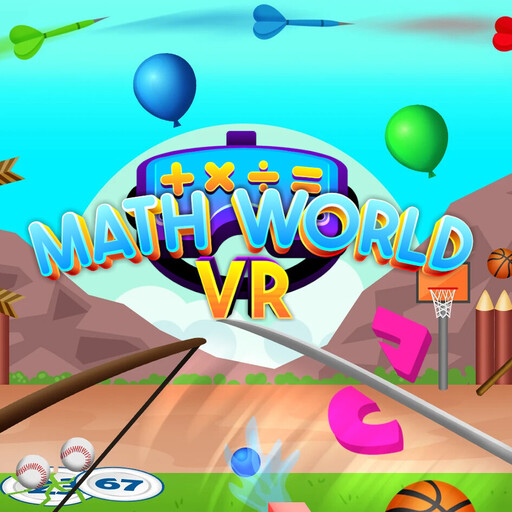

We are proud to share that Math World VR has been awarded the Best In STEM™ distinction by STEM.org Educational Research™, with an overall assessment of 95 out of 100. The award was issued on September 29, 2026, and carries its own verification record under award STEM ID 900000022.
For a small studio like ours, this is a meaningful moment. We built Math World VR around a simple idea: arithmetic practice does not have to feel like a worksheet. It can feel like throwing a basketball, drawing a bow or hitting a target, with a math problem sitting at the center of every action. Seeing that idea recognized by an organization focused on STEM education is a real encouragement for our whole team.
In its review, STEM.org described Math World VR’s strongest educational opportunity as the connection between a mathematical decision, a purposeful action and an immediate response. That line captures what we have been trying to build from the start. A learner solves a problem, acts on the answer and sees the result right away.
In this post we want to share what the award is, what the reviewers said, what it does and does not mean, and how teachers and families can get the most out of Math World VR.
What Math World VR is
Math World VR is a virtual reality game that pairs simple arithmetic with twelve sports and arcade mini-games. Every round asks the player to work out a math problem and then act on the answer, whether that means throwing, shooting, slicing or swinging.
The twelve mini-games are:
- Axe Throwing
- Bow & Arrow
- Basketball Free Throw
- Punch The Plates
- Number Slicer
- Baseball Throw (listed as Plate Breaker on the PlayStation and Steam store pages)
- Target Marksman
- Carnival Darts
- Frisbee Toss
- Mini-Golf
- Multiples Paintball
- Slingshot
The math is woven directly into the action. In Bow & Arrow, players shoot at the target showing the correct answer to an equation. In Carnival Darts, they throw darts at balloons while sorting even and odd numbers. Each mini-game has adjustable difficulty, running from easy up to pro, so players can raise the challenge as their arithmetic gets stronger.
We designed Math World VR to be playable for all ages, and it is rated E for Everyone. It can be played while stationary, sitting or standing, which matters a lot in a classroom or a living room with limited space. On Meta Quest, it does not require an internet connection and supports English, Chinese, Japanese and Spanish.
Math World VR first launched on Meta Quest on May 3, 2022. It came to PlayStation VR2 on June 29, 2023, and to Steam for PC VR on December 15, 2023. It is available on Meta Quest, PlayStation 5 and Steam.
What the reviewers highlighted
STEM.org scored Math World VR across six categories of its Educational Experience rubric, for a total of 95 out of 100. We earned full marks in two categories and lost no more than two points in any other.
| Category | Score | What the review noted |
|---|---|---|
| STEM integration & learning design | 29 / 30 | A clear mathematical focus, built on arithmetic tasks and adjustable challenge |
| Applied learning & problem solving | 18 / 20 | Interactive number selection gives players a concrete setting for repeated decisions |
| Facilitator readiness & resources | 14 / 15 | School information, implementation guidance and supporting resources help educators understand the offer |
| Learner experience & accessibility | 14 / 15 | Difficulty options give a starting point for differentiation |
| Stakeholder/community engagement | 10 / 10 | School support and free educational materials show a commitment to educators and families |
| Feedback & continuous improvement | 10 / 10 | The feedback loop in the game can support practice and reflection |
| Overall | 95 / 100 | Best In STEM™ |
The review also pointed to the official screenshots of our basketball and archery games. In the basketball game, an addition problem appears right inside a timed play environment. In the archery game, the numbered targets sit inside the scene itself, so choosing the right answer and aiming at it are the same action.
The reviewers noted that the twelve mini-games and four difficulty settings give teachers a way to revisit the same skill without repeating the same presentation. That variety is something we built in on purpose. A student who has practiced addition at the free-throw line can practice it again with a slingshot or a frisbee, and the math stays fresh.
The reviewers also recognized the wider work around the game. That includes our school information pages, our VR for All Schools hardware-access initiative and our free educational book collection, which includes the math-themed story Max Quantum & The Fraction Phantom.
Our accreditation, renewed through 2027
Alongside the new award, both Skill Prepare and Math World VR have renewed their STEM.org Accredited™ Educational Experience credentials through September 26, 2027. These credentials were first issued on September 26, 2022, and they keep their original STEM IDs and issue dates.
| Recognized | Credential | STEM ID | Validity |
|---|---|---|---|
| Math World VR | Best In STEM™ · 95/100 | 900000022 | Issued September 29, 2026 |
| Math World VR | Accredited™ Educational Experience | 59034086 | Through September 26, 2027 |
| Skill Prepare | Accredited™ Educational Experience | 59034085 | Through September 26, 2027 |
The accreditation is why you will see Math World VR described as a STEM Accredited VR game on its store pages. This year marks four years since Skill Prepare and Math World VR were first accredited. Adding the Best In STEM distinction on top of that is a milestone we are very proud of.
The Best In STEM distinction belongs specifically to Math World VR. It does not cover our other titles, and it does not change the annual accreditation term.
How the review was done
We want to be clear and honest about what this award represents. STEM.org based its review on our official website and our published product materials. Those materials included the Math World VR product page and screenshots, our educational VR FAQs, our school information pages, VR for All Schools and our free book collection. The review also drew on our accreditation records going back to 2022.
The review was not a hands-on play test or a study of measured learning outcomes. STEM.org states that its category scores are review judgments, not empirical measurements or a ranking against other products. The 95/100 reflects the educational design and potential of Math World VR, not a claim that it outperformed a tested group of competing games.
We think that honesty matters, especially for teachers deciding what to bring into their classrooms. The award tells you that an organization focused on STEM education looked closely at how Math World VR is designed and liked what it saw. The best way to judge the learning itself is to watch your own students play, explain and solve problems.
Using Math World VR in the classroom
One of the most useful parts of the STEM.org report is a simple four-step routine for teachers. It is designed to make the learning visible, so a high game score is not mistaken for strong understanding. We think it is a great way to use Math World VR with students.
- Prepare: choose one learning target. Start with a short problem on paper that shows how the student currently thinks. Then pick a mini-game and difficulty level that fit that goal. Plan how students without a headset can take part by watching, discussing or solving alongside.
- Play: keep attention on the math. Ask the student to explain their answer before or after a round. Watch whether any trouble comes from the numbers, reading the problem, the time limit or the controllers, and note those separately.
- Explain: turn an answer into a strategy. Ask for a second way to solve the same problem. A partner can describe a pattern, draw a picture of the problem, or find a wrong answer that looks right and explain why it fails.
- Transfer: check the idea outside the headset. Give a similar problem on paper or with objects. Ask the student to justify the answer and say what stayed the same.
The report suggests one question to ask after every round: how did you know, and could you solve a similar problem without the game? The answer helps a teacher tell the difference between a student who enjoyed the round, a student who is quick with facts and a student who truly understands.
The report also makes a point we agree with completely. A correct answer followed by a missed throw is not a math mistake. Some students are still getting comfortable with VR controllers, and that is a different skill from arithmetic. Asking students to say their answer out loud before they throw helps separate the two.
What comes next
A good review does more than hand out a score. It also shows where there is room to grow, and the STEM.org report gives us three clear recommendations.
- Make versions and expectations easy to compare. Keep one up-to-date reference covering platforms, content version, learning goals and difficulty, so teachers know exactly what they are getting on each headset.
- Document inclusive participation. Describe controller demands, available settings, supervision needs and alternatives for students who cannot or choose not to use a headset.
- Build a small learning-evidence portfolio. Collect anonymized student work from before and after a focused activity, along with the student’s explanation and a similar problem solved outside the game.
The report also suggests a one-page implementation sheet for Math World VR. It would cover compatible devices, classroom setup, choosing a learning goal, ways to participate and a sample record of learning. It points to companion tasks as well: a number discussion before play, a short reflection afterward and a problem students can share with a teacher or family member.
These are practical, useful ideas, and we are grateful for them. They fit the direction Skill Prepare has always taken. Math World VR sits alongside our other subject-based titles, Reading World VR and Science World VR, as well as our free educational books and our VR for All Schools initiative. Our goal across all of it is the same: making learning something students want to do.
Thank you
We want to thank STEM.org and its Founder and Executive Director, Andrew B. Raupp, for the review, the award and the continued partnership since 2022. We also want to thank every teacher, parent and player who has picked up a controller and given Math World VR a try. Your feedback is a big part of how the game has grown.
Most of all, this award belongs to the students. Every throw, shot and swing in Math World VR starts with a math problem, and every one of those problems is solved by a learner choosing to give it a go.
If you would like to verify our credentials, you can look them up on STEM.org using the IDs below:
- Math World VR, Best In STEM™: STEM ID 900000022
- Math World VR, Accredited™ Educational Experience: STEM ID 59034086
- Skill Prepare, Accredited™ Educational Experience: STEM ID 59034085
To try Math World VR, find it on Meta Quest, PlayStation VR 2, PICO, and Steam. Schools interested in bringing it into the classroom can learn more at skillprepare.com.
Sources
- STEM.org Educational Research™, Math World VR · Accredited™ + Best In STEM™ Review Report, September 29, 2026
- Math World VR on the Meta Quest store
- Math World VR on Quest Store DB (Quest release date, languages, play modes)
- Math World VR on Deku Deals (PlayStation 5 and Steam release dates)